
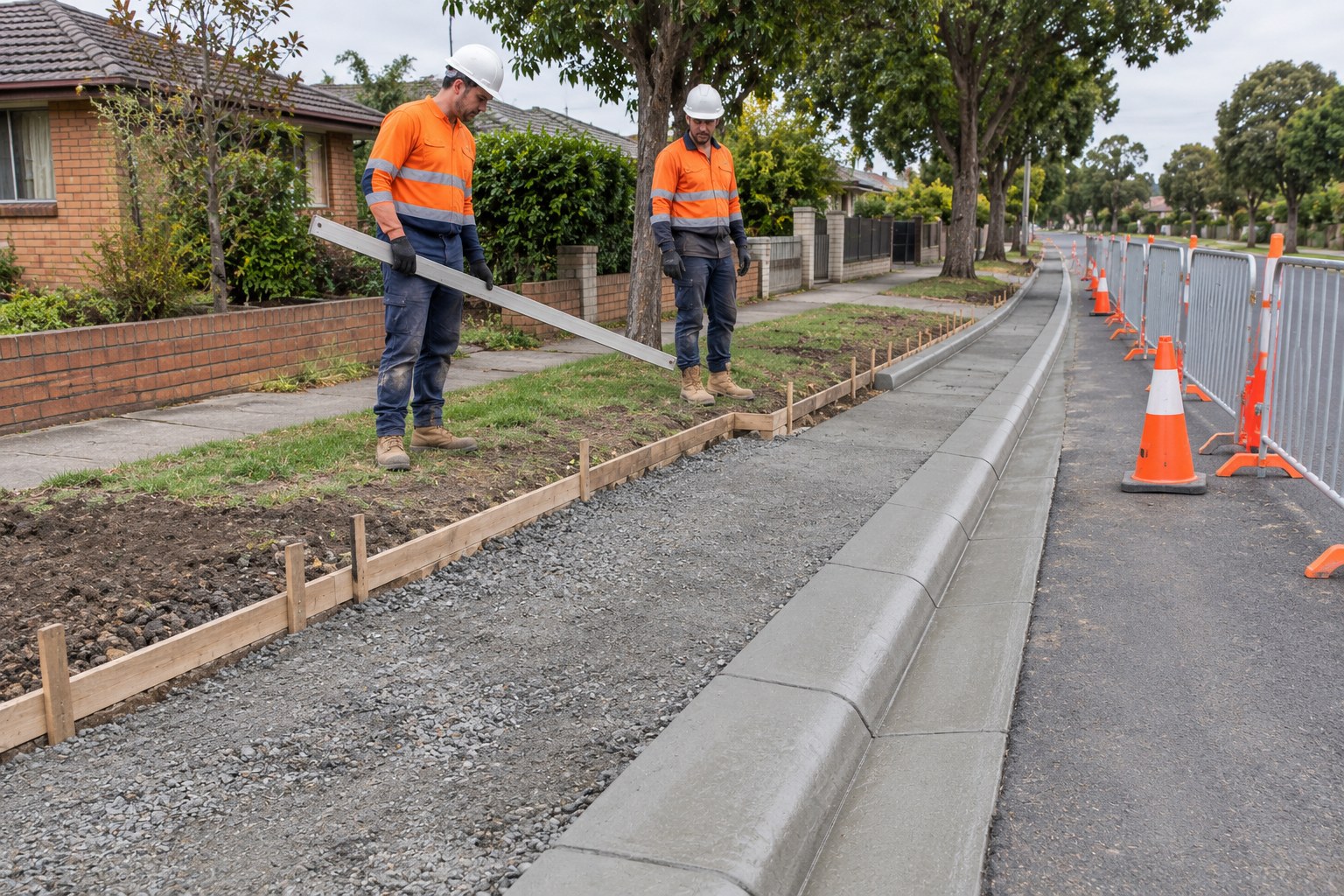
Civil concrete is concrete used in public and private infrastructure rather than inside a building: kerbs and channels, footpaths, vehicle crossings, drainage pits, culverts, headwalls, retaining walls, pavements and bridge components. It is built to council and road authority specifications, often in the road reserve, and has to survive traffic, water and weather for decades with little maintenance.
The materials are the same cement, aggregate and steel used everywhere else. What changes is the specification, the approvals and the conditions the concrete must handle. This guide explains the main types of civil concrete, the standards behind them, and the order the work happens on site.
The term describes where concrete is used and who sets the rules, not a special mix.
Civil concrete can be structural or non-structural. A culvert or a bridge deck is structural. A footpath is usually not, although it still has to meet a minimum strength and finish.
| Civil Element | What It Does | Typical Location |
|---|---|---|
| Kerb and channel | Edges the road and carries stormwater to pits | Streets, estates, car parks |
| Footpaths and shared paths | Pedestrian and bicycle access | Road reserves, parks |
| Vehicle crossings | Connect a property driveway to the road across the footpath and kerb | Every property frontage |
| Drainage pits and headwalls | Collect and discharge stormwater | Roads, drains, waterways |
| Culverts | Carry water under roads and tracks | Creeks, table drains |
| Concrete pavements | Heavy-duty trafficked surfaces | Loading docks, bus stops, industrial yards |
| Retaining walls | Hold back earth beside roads and paths | Cuttings, embankments, boundaries |
| Bridge and structure components | Decks, abutments, piers | Road and rail crossings |
Small civil items, such as a single vehicle crossing, are often part of a house build. Larger items, such as culverts and bridge components, belong to infrastructure projects with their own engineering and contracts.
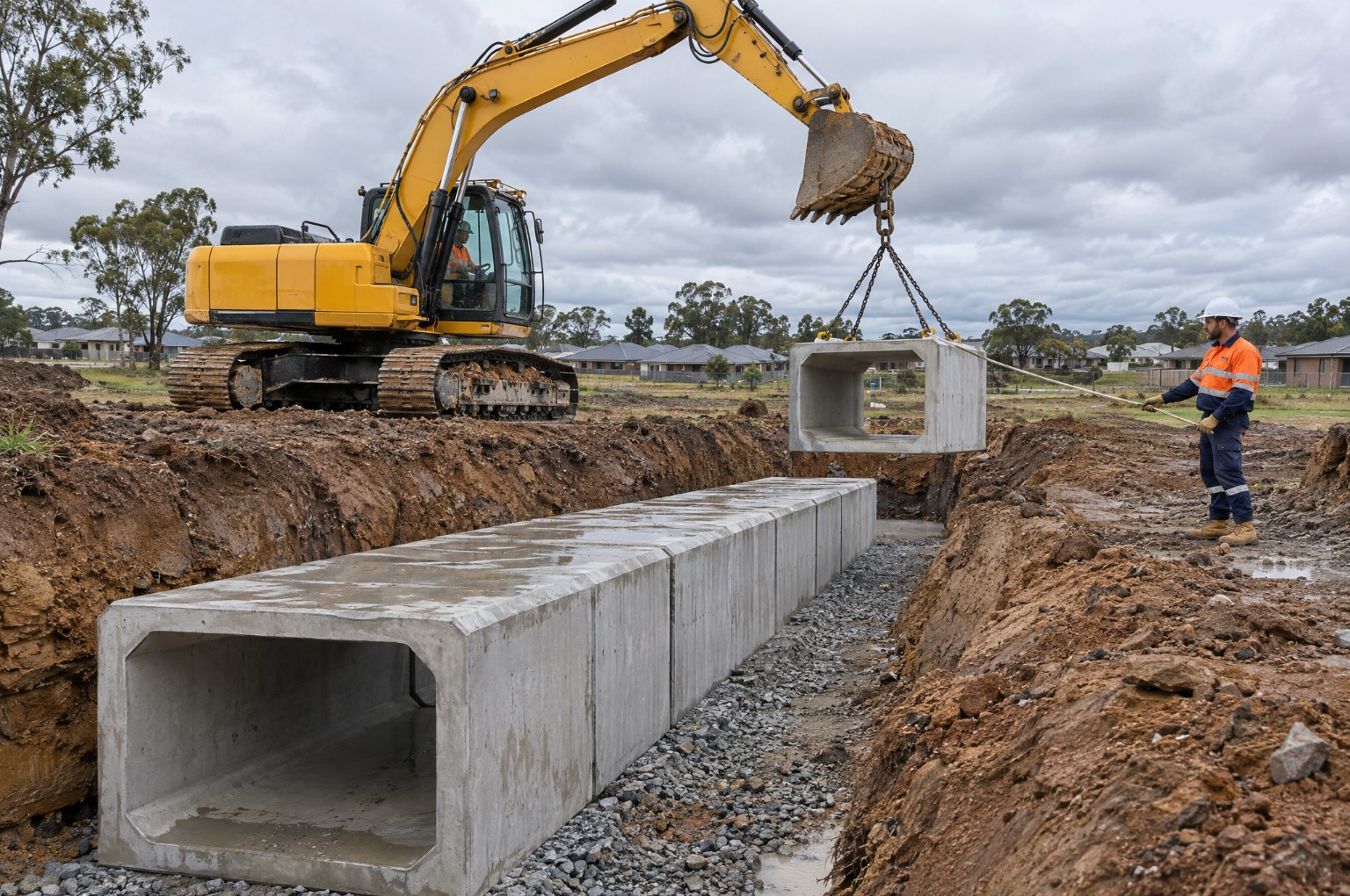
Civil concrete in Victoria usually follows three layers of requirements.
Concrete supply follows AS 1379, and designed concrete structures follow AS 3600. Bridges and many road structures are designed to AS 5100. Precast products, such as culverts and pipes, have their own product standards.
The Department of Transport and Planning (formerly VicRoads) publishes standard specifications for roadworks and bridgeworks. Section 610 covers structural concrete, and Section 703 covers general concrete paving such as paths, kerbs and other surfacings. Many councils adopt these sections in their own contracts. The full list sits in the department's technical publications library.
Each council publishes standard drawings for kerb profiles, footpaths and vehicle crossings, and requires a permit before anyone works on its assets. For example, the City of Melbourne requires a vehicle crossing permit to construct, remove or modify a crossing, and crossings on major (declared) roads also need Department of Transport approval.
The sequence below suits most cast-in-place civil items, from a vehicle crossing to a run of kerb and channel.
Drawings are prepared to the relevant standard drawing or engineering design. Permits are obtained from the council or road authority, and underground services are located before any digging.
Work in the road reserve needs a traffic management plan to protect pedestrians and vehicles. Levels and alignments are set out so the finished concrete drains correctly.
The area is excavated to design depth, soft spots are removed, and a crushed rock subbase is placed and compacted. A poor subbase is the most common reason civil concrete cracks and settles early.
Edge forms are fixed to line and level. Reinforcement mesh or bars are placed on chairs where the design calls for them, such as in heavy-duty vehicle crossings and pavements. Kerbs are often slip-formed by machine instead.
Concrete is placed, compacted and finished to the specified surface. Footpaths and crossings usually receive a broom finish for slip resistance. Joints are tooled or sawcut to control cracking.
Curing keeps the surface moist while the concrete gains strength. The council inspects the work against its permit conditions, and surrounding areas such as nature strips and road edges are reinstated.
| Feature | Civil Concrete | Structural (Building) Concrete | Residential Flatwork |
|---|---|---|---|
| Typical elements | Kerbs, paths, crossings, culverts, pavements | Footings, slabs, columns, walls | Driveways, patios, paths on private land |
| Governing documents | Council drawings, road authority specifications, AS 1379, AS 3600 or AS 5100 | AS 3600, AS 2870, structural drawings | Builder specification, AS 1379 |
| Approvals | Council or road authority consent | Building permit | Often none on private land |
| Main loads | Traffic, water flow, weather | Building loads | Light vehicles and foot traffic |
| Long-term owner | Often council or authority | Property owner | Property owner |
Our guide to structural concrete covers building elements in more detail, and our article on concrete driveways in Melbourne covers private flatwork.
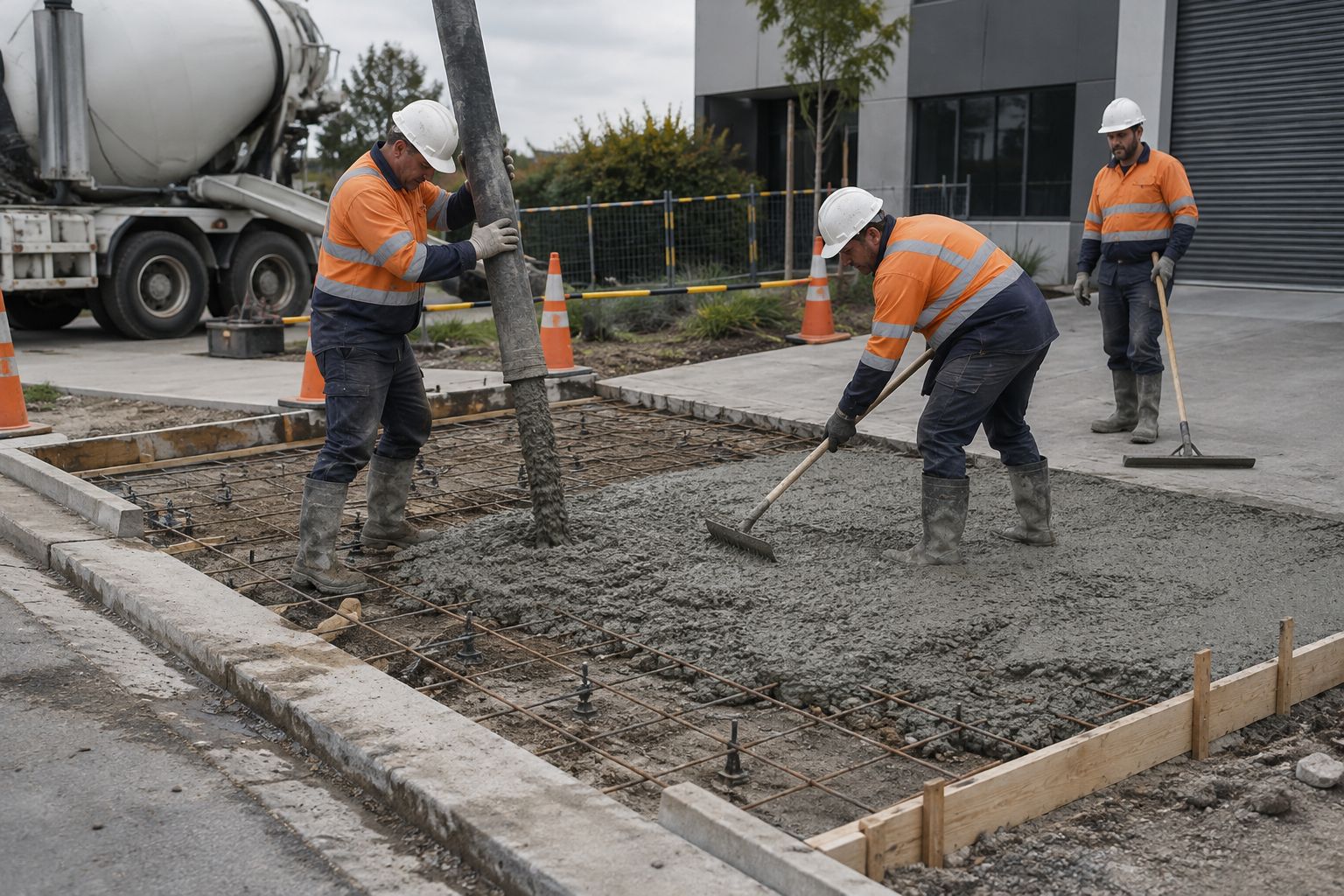
Civil concrete is usually priced per item or per linear or square metre, but the rate depends heavily on the site.
| Cost Factor | Why It Matters |
|---|---|
| Permits and inspections | Council fees and inspection hold points |
| Traffic management | Required whenever work affects a road or footpath |
| Excavation and subbase depth | Deeper boxing and more rock for heavy-duty areas |
| Reinforcement and concrete grade | Set by the standard drawing or engineering design |
| Existing services and trees | Hand digging, protection or authority consent |
| Removal of old concrete | Sawcutting, breaking and disposal |
| Access and pour size | Small pours and pump hire spread over little volume |
Pump access often decides the programme on tight streets. Our article on concrete pumping in Melbourne explains the options.
Civil concrete is used for infrastructure outside buildings: kerbs and channels, footpaths, vehicle crossings, drainage pits, culverts, headwalls, retaining walls, concrete pavements and bridge components. Most of it sits in road reserves, drainage corridors and public spaces.
Not necessarily. Civil concrete uses the same strength grades as other concrete, but the specification sets the grade, cover and finish for the conditions. A footpath may use a modest grade, while a bridge component or heavy-duty pavement uses a much higher one.
Yes. Councils require a vehicle crossing permit for new, relocated or modified crossings, and the work must follow the council's standard drawings. Crossings on major roads also need approval from the Department of Transport.
This varies by council. Many councils make the property owner responsible for building and maintaining the crossing, even though it sits on council land. Check your council's vehicle crossing guidelines before starting work.
Civil concrete describes where concrete is used: infrastructure such as roads, drains and paths. Structural concrete describes what it does: carry loads in a structure. Some civil concrete, such as culverts and bridge decks, is also structural.
Civil concrete succeeds on the basics: the right specification, a properly compacted subbase, correct falls and permits in place before the first pour.
Urban Pour delivers concrete work across Melbourne, and our article on civil concrete contractors in Melbourne explains what to expect when engaging one. Contact Urban Pour to discuss your drawings and site.
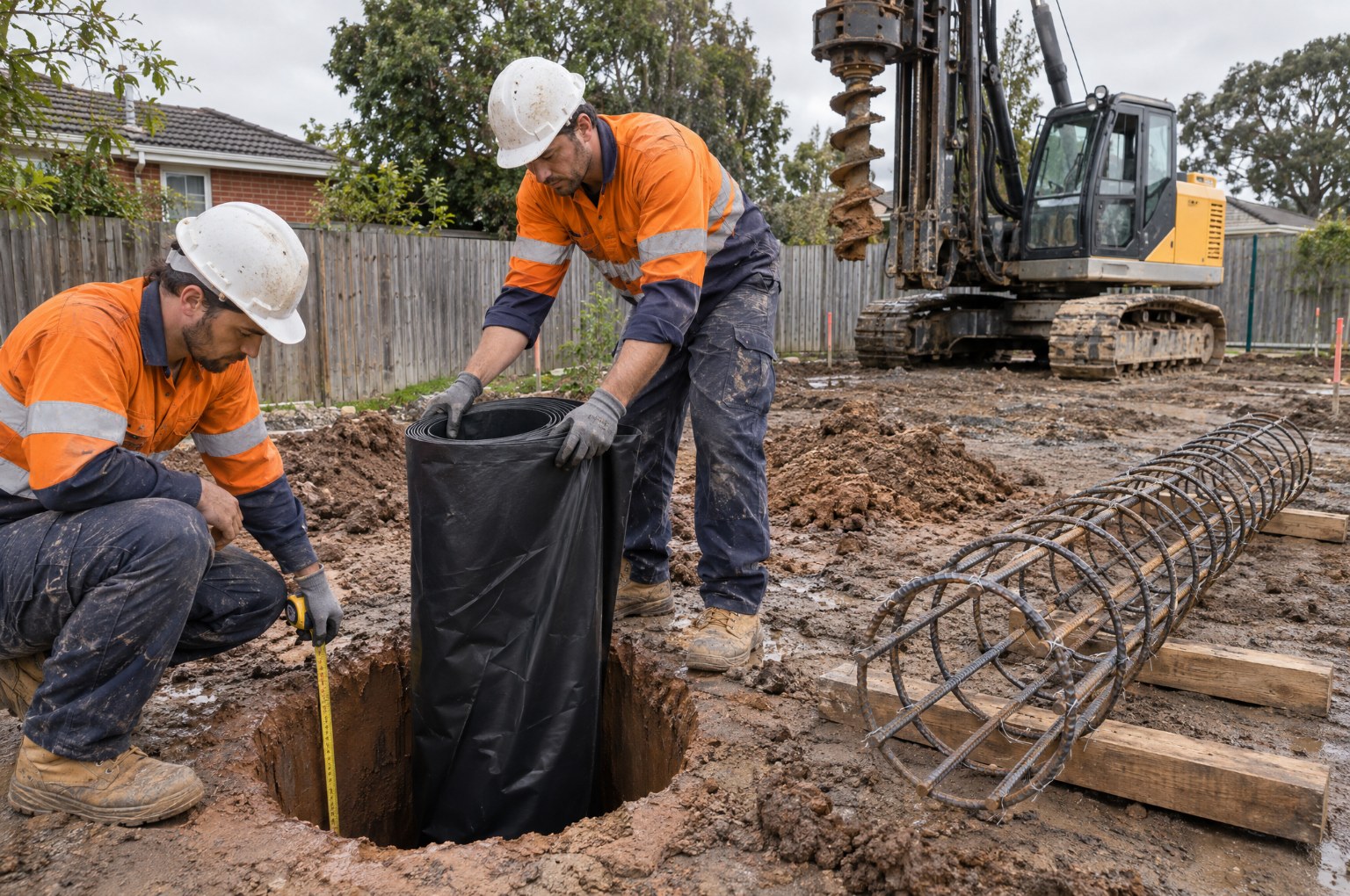
What pile debonding is, why piers in reactive clay or settling fill need it, and how sleeves and coatings are installed.
See more
What causes slab heave on Melbourne's reactive clay, the early signs to watch for, and how to prevent and repair it.
See more
What each AS 2870 site class means, how a soil test sets the class, and how it changes your slab and footings.
See more