
Melbourne’s Leading Concrete Pouring Specialists
Oops! Something went wrong while submitting the form.

Bulk excavation is the large-scale removal of soil, rock or fill to bring a construction site close to its required overall levels before more precise footing, trench or structural excavation begins.
In Melbourne, bulk excavation is commonly used for basements, major site cuts, underground car parks, commercial developments and residential projects where substantial volumes of material need to be removed.
The objective is not simply to move as much soil as possible. The excavation needs to reach the correct reduced levels, remain stable during construction, allow spoil to leave the site efficiently and prepare the area for the structural works that follow.
Bulk excavation is the high-volume stage of earthworks.
It removes the main mass of material from a site before detailed excavation creates the smaller structural features such as:
WorkSafe Victoria describes bulk excavations as common where projects need large below-ground spaces, including basements, underground parking and retaining structures.
Bulk and detailed excavation usually occur at different stages.
Bulk excavation removes volume.
Detailed excavation creates precision.
For example, a basement may first be excavated several metres below natural ground level using large plant. Once the main basement level has been reached, smaller equipment can form lift pits, footings and drainage trenches.
Treating both operations as one uncontrolled excavation can increase the risk of over-digging structural areas.
Bulk excavation is most useful where significant volumes need to be removed.
A basement can require almost the entire building footprint to be excavated below ground level.
A sloping or elevated block may need substantial material removed before the building platform reaches the required level.
Larger residential and commercial projects often require deep excavation over a broad footprint.
Material may need to be removed before permanent retaining walls or other ground-retention systems are installed.
Larger footprints and below-ground structures can generate substantial spoil volumes.
Bulk excavation is less relevant where only small footing trenches or service runs need to be excavated.
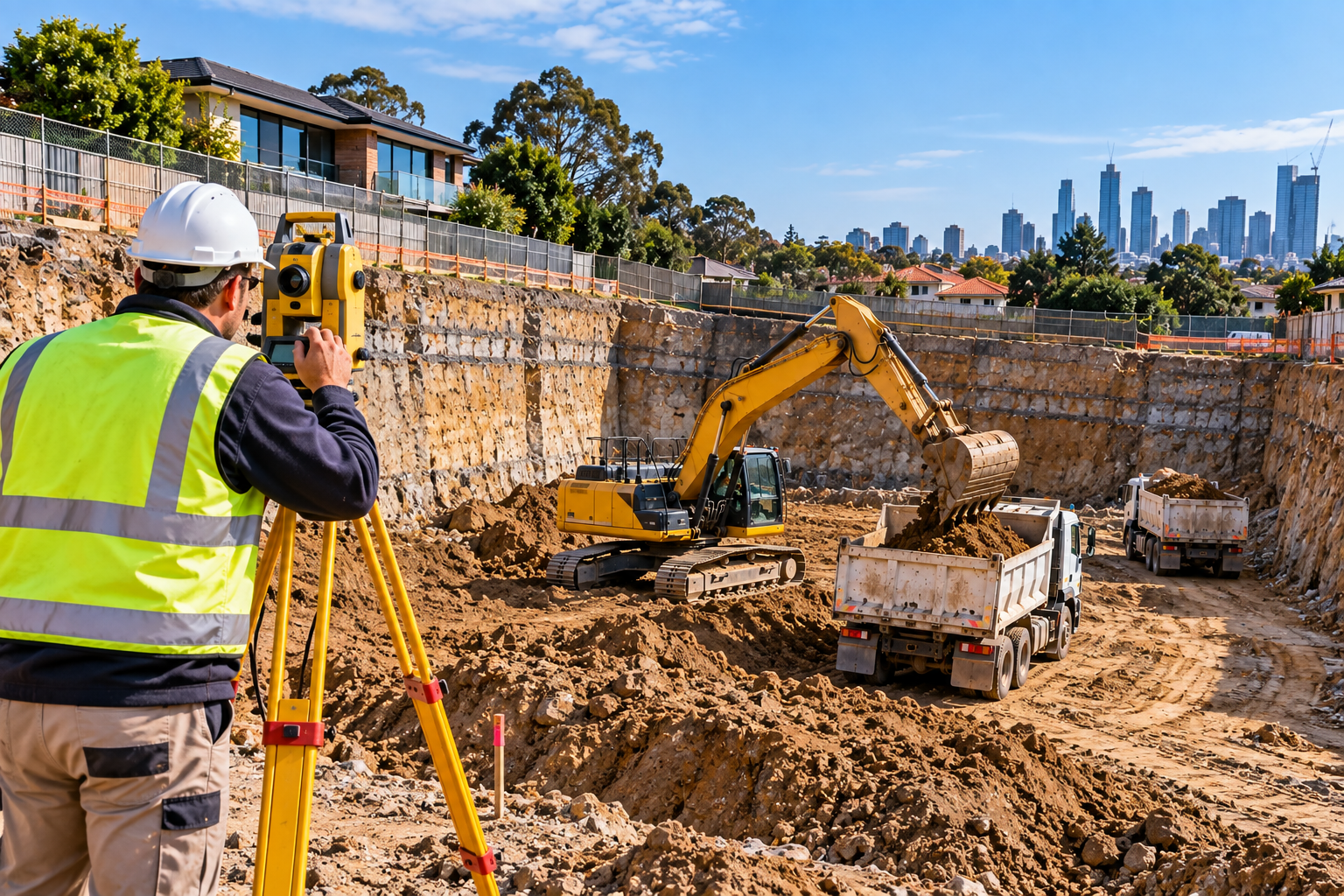
A successful bulk cut starts with levels and logistics.
Before excavation begins, the contractor needs to understand:
The excavator operator should not be determining the final depth by eye.
Survey control provides reference points for the excavation.
This helps prevent:
Topsoil, organic material and other unsuitable material are removed where the structure will be built.
Large plant removes the primary volume of material.
The excavation may progress in stages rather than immediately going to final depth across the entire site.
As depth increases, cut faces may need to be:
The method depends on ground conditions, excavation depth and nearby structures.
Soil is stockpiled or loaded directly into trucks.
Efficient truck circulation can have a major effect on overall excavation productivity.
The final part of the excavation needs tighter control.
Leaving some material for final trimming can reduce the risk of excavating below the required structural level.
Before detailed excavation begins, levels should be checked against the survey and drawings.
The best equipment depends on volume, access, depth and ground conditions.
Tracked excavators are the main machines used for bulk excavation.
Larger machines generally offer:
But bigger is not always better.
Restricted residential sites may limit:
Smaller excavators are useful where:
They are generally slower for moving large quantities of soil.
These machines can help:
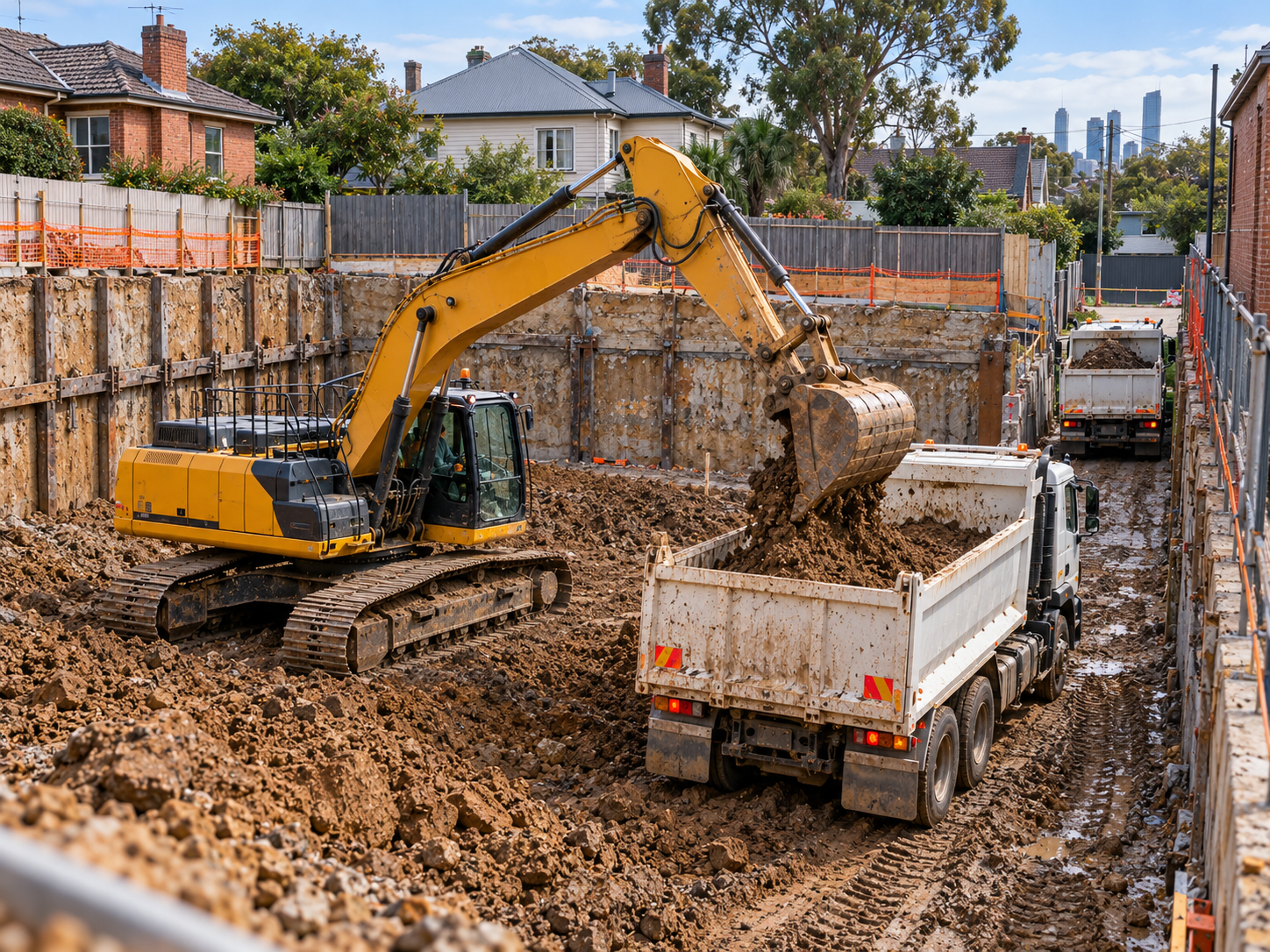
Bulk excavation produces large spoil volumes, so truck productivity matters almost as much as excavator productivity.
The excavation can slow down if the machine has to wait for trucks.
Where rock is encountered, hydraulic breakers may be needed before the material can be excavated and loaded.
Bulk excavation needs level control throughout the cut.
The important level is the reduced level, or RL, specified in the project documentation.
An incorrect RL can affect:
Urban Pour's existing site-cut work explains why reduced levels should be established from survey control rather than from the apparent ground surface.
Excavation normally becomes more controlled as the machine approaches final level.
Over-excavation is particularly undesirable because material removed from beneath a structural element cannot always be replaced with loose site soil.
Basements are among the clearest applications for bulk excavation.
The main basement footprint may need to be cut several metres below natural ground.
That excavation needs to coordinate with:
On a tight site, the excavation may also occur close to adjoining buildings or property boundaries.
That can change how the excavation progresses.
For example, material may need to be removed in stages as temporary or permanent retention is installed.
During residential basement construction, excavation sequencing needs to align with the structural system rather than being treated as a separate dirt-removal operation.
A sloping block can require significant cut before the building platform reaches the design level.
The excavation may leave a high face on the uphill side of the site.
That face cannot simply be assumed to remain stable.
Where appropriate, site benching can divide a deeper cut into stepped levels rather than leaving one high unsupported face.
The final solution can depend on:
Bulk excavation and ground support therefore need to be planned together.
Spoil removal is one of the biggest logistical components of bulk excavation.
Large cuts can generate many truckloads of soil.
Productivity depends on:
Where possible, the excavator loads trucks directly.
This reduces handling.
If trucks cannot keep up with excavation, soil may need to be temporarily stockpiled.
That requires enough available site space.
On restricted sites, material may first be moved to another area before it can be loaded.
Every additional handling stage adds time and cost.
The same excavation volume can require very different work depending on the ground.
Clay can often be excavated efficiently with conventional buckets, but wet clay can become difficult to handle and transport.
Loose material can increase excavation-face stability concerns.
Unknown or uncontrolled fill can contain:
It can also change foundation conditions.
Rock significantly changes production rates and equipment requirements.
Wet ground can reduce machine mobility and excavation stability.
Rock can change both production and cost.
Depending on hardness and extent, it may require:
Rock excavation can also create vibration concerns near neighbouring structures.
If the geotechnical report indicates shallow rock, it should be considered in the excavation plan before work begins.
Groundwater can enter deep excavations through:
Water can:
Basement excavation may require pumping or a designed dewatering strategy.
Groundwater management should be resolved before the site is ready for structural concrete.
Bulk excavation creates serious hazards because both workers and heavy plant operate around deep, open ground.
WorkSafe Victoria identifies common bulk-excavation hazards including:
WorkSafe also recommends obtaining advice from a suitably qualified person about ground conditions and the appropriate support or retention system before bulk excavation begins.
Ground support may involve:
The correct system depends on the site.
There is no reliable universal rate for bulk excavation.
The largest cost drivers include:
Consider two projects requiring the same excavation volume.
Site A
Site B
The volume may be identical, but the cost and programme can be very different.
That is why bulk excavation is best priced from actual site conditions rather than cubic metres alone.
Over-excavation can create extra remediation, fill or concrete requirements.
Incorrect reduced levels can flow through the entire project.
The excavator may sit idle if trucks cannot remove spoil quickly enough.
A deep excavation can become unsafe if faces are left unsupported.
Removing material before retaining systems or piling are ready can create unnecessary risk.
Unexpected water can halt excavation and damage the finished founding surface.
Bulk excavation usually stops before every structural detail has been completed.
The site then progresses into detailed work such as:
At that point, the work transitions from high-volume earthmoving to precision excavation.
Where foundations require support below the main excavation level, bored piers can transfer structural loads into deeper competent ground.
Only after the final levels and founding conditions are confirmed should the project progress into footings, slabs and other structural concrete.
Bulk excavation needs to be planned around more than the amount of soil being removed.
The reduced levels, machinery, truck movements, ground support, spoil destination and structural sequence all affect how efficiently the excavation can be completed.
Urban Pour provides site benching and excavation in Melbourne alongside basement, foundation and structural concrete works, allowing the bulk excavation to be coordinated around what needs to be built once the main cut is complete.
Bulk excavation is the large-scale removal of soil or rock to establish the main construction levels before detailed footing, trench or structural excavation begins.
Tracked excavators are the main machines. Trucks remove spoil, while compact loaders, mini excavators and rock breakers may be used depending on access and ground conditions.
Bulk excavation is one part of earthworks. Earthworks also includes filling, grading, compaction and reshaping the site.
Yes. Basement construction often requires large volumes of soil to be removed before footings, slabs and retaining walls can be built.
Bulk excavation removes volume and establishes overall levels. Detailed excavation forms precise footings, pits and trenches after the main cut.
Cost depends on volume, ground conditions, rock, access, spoil disposal, trucks, excavation depth and ground-support requirements.
The project normally moves into detailed excavation, final level checks and foundation preparation before structural concrete works begin.
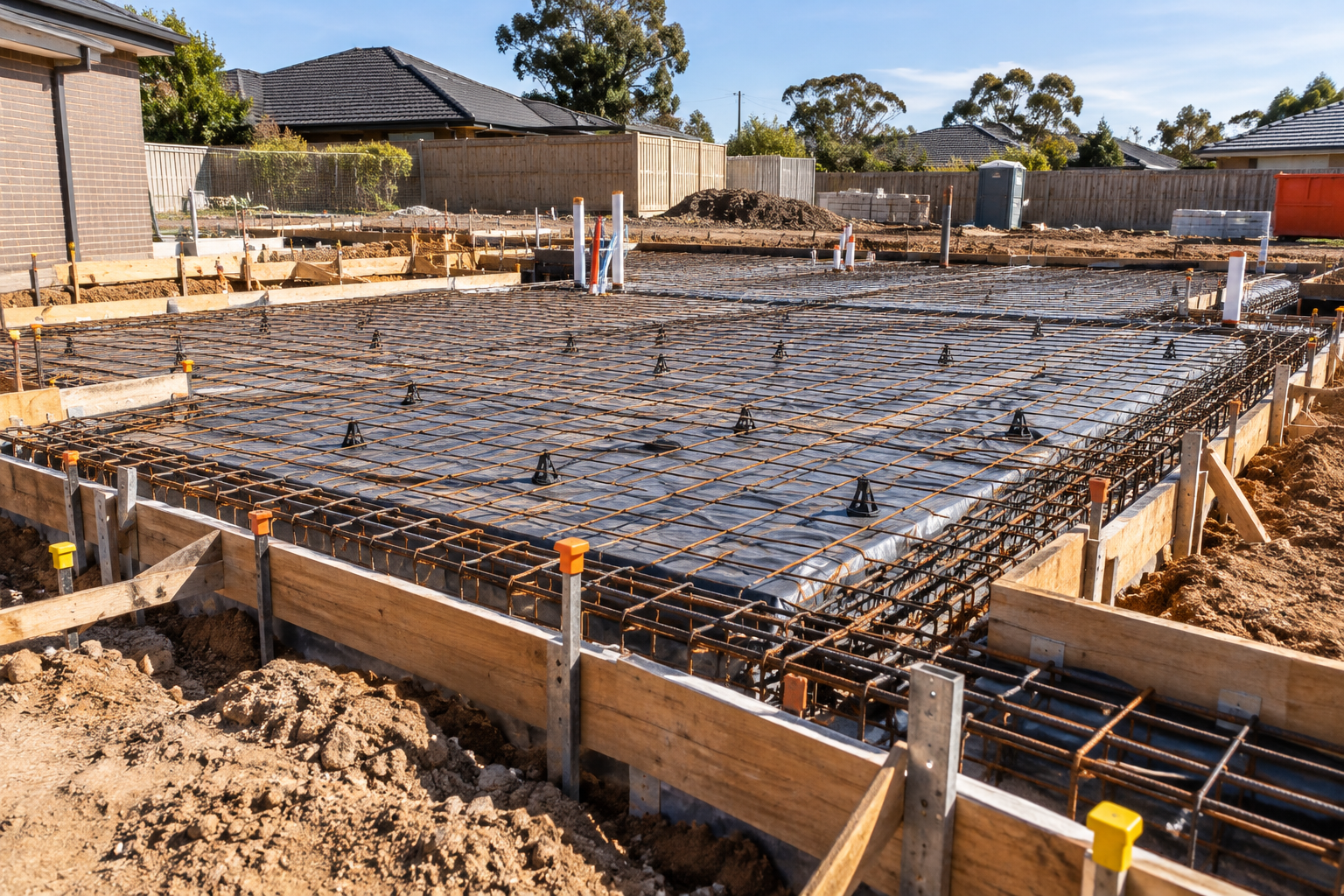
Learn how concrete slabs are designed and built in Australia, including slab types, site classification, reinforcement, pouring, curing and the standards that govern each stage.
See more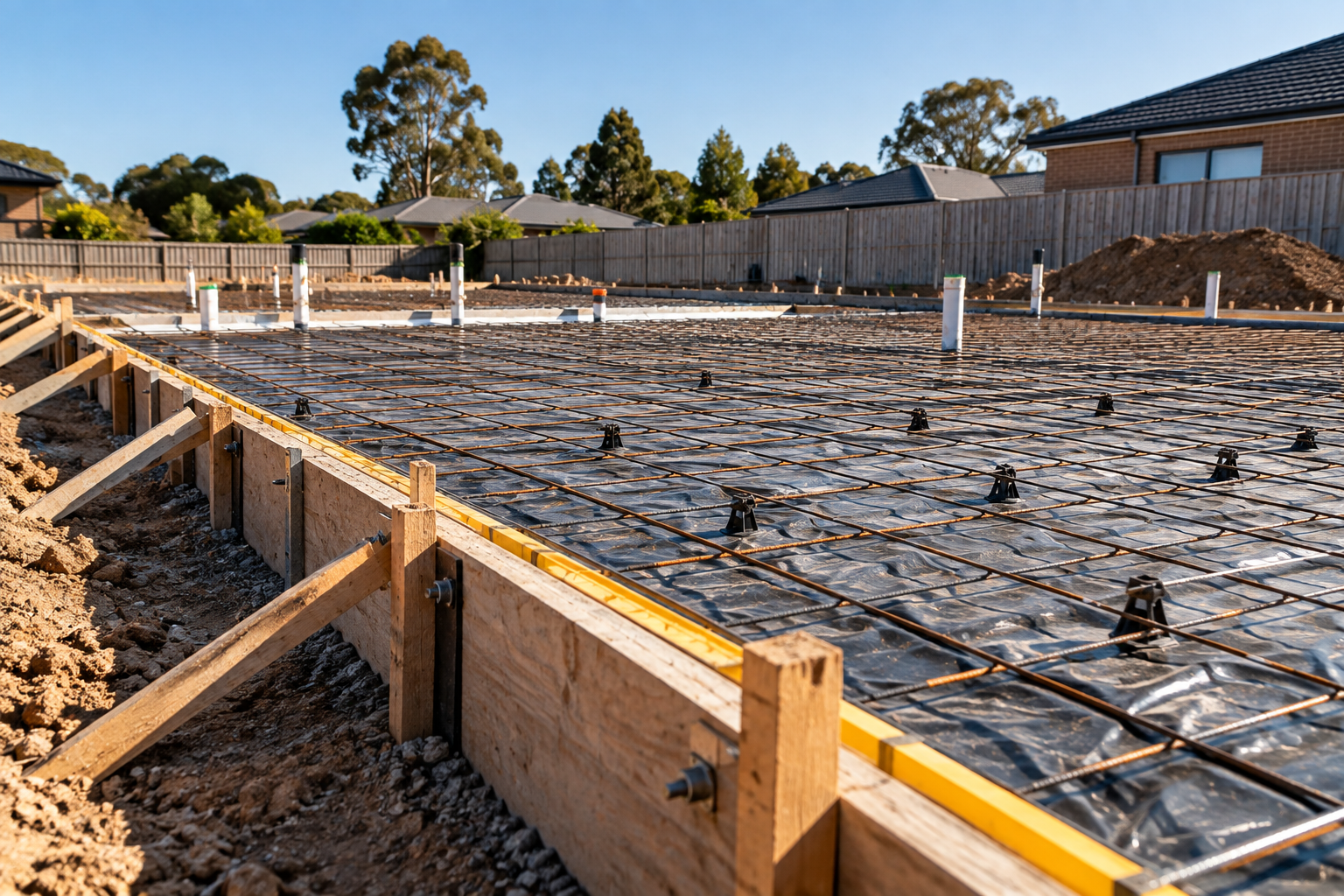
Calculate concrete slab volume in cubic metres, then account for beams, thickenings, waffle pods, subgrade tolerance and pump losses before ordering.
See more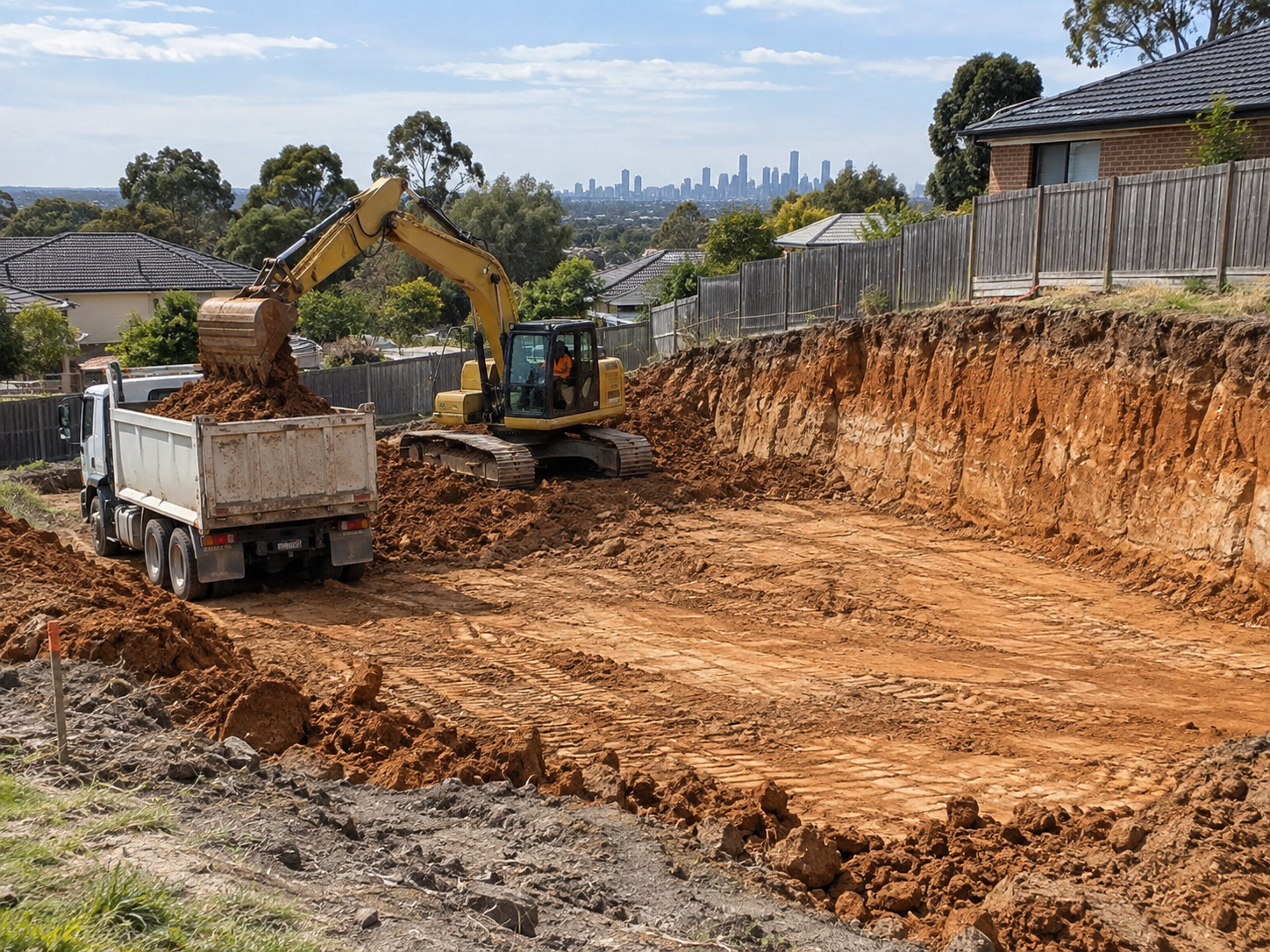
Site cut vs site benching explained for Melbourne builders, including excavation methods, safety requirements, ground conditions and what to check before earthworks begin.
See more