
Melbourne’s Leading Concrete Pouring Specialists
Oops! Something went wrong while submitting the form.

Tight access excavation in Melbourne is digging carried out where standard plant cannot reach the work area: behind terrace houses, down narrow side paths, under existing buildings and on blocks hemmed in by neighbours. It relies on compact machines, staged spoil removal and careful sequencing rather than brute machine size.
That changes how a job is planned, priced and programmed. A dig that would take a 20 tonne excavator a day on an open site can take several days with a mini excavator and a tracked dumper. Below is how the work is done, what equipment suits which gap, and the site constraints that decide whether a tight access job runs smoothly.
A site is generally treated as tight access when the entry point, the working room or the overhead clearance stops a conventional excavator and tipper from working side by side.
In Melbourne that usually means one of the following:
Inner suburbs with terrace housing, rear laneways and small lots produce most of this work, along with rear extensions, pools, underpinning and basement projects on established streets.

The assessment decides the machine, the method and the price. Measuring the gate is only the start.
The narrowest point along the whole route sets the machine size, not the gate alone. Hot water units, meter boxes, downpipes, eaves and steps all reduce the usable width. Paths, pavers and driveways on the route may need plywood or track mats to prevent damage.
Tight sites often carry sewer, stormwater, gas, water and electrical lines close to the dig. A Before You Dig Australia enquiry identifies registered assets, and private services on the property are located separately before any machine breaks ground.
Melbourne ground varies sharply by area. Hard basalt is common across the north and west, weathered siltstone and mudstone underlie much of the east, sandy soils are common in the bayside south-east, and soft silts occur around the lower Yarra. Rock needs a hydraulic breaker, which is slower with a small carrier machine. Sand and soft ground need support sooner.
Where an excavation could affect an adjoining property, the relevant building surveyor may require protection work. In Victoria the owner then serves a protection work notice on the adjoining owner before work proceeds. The VBA protection work statement sets out each party's role.
Most jobs combine several methods. The right mix depends on depth, soil and how far the spoil has to travel.
Mini and micro excavators do the bulk of the digging. Zero tail swing models can slew within their own track width, which lets them work beside a wall without striking it.
Hand digging is used beside footings, around live services and in spots no machine can reach. It is slow, so it is kept to the areas that need it.
Vacuum excavation uses pressurised water or air to loosen soil and a suction hose to remove it. It exposes services without striking them and can reach a rear yard through a hose run from a truck parked in the street.
Next to a boundary or an existing footing, the ground is opened in short alternating sections. Each section is supported or concreted before the adjoining one is dug, so the neighbouring structure is never left unsupported along its full length.
Lowering a floor or digging under a house uses micro machines and powered barrows, with spoil moved out by conveyor or dumper. This approach is common where a basement or underpinning to an existing house is involved.

Machine sizes below are typical classes. Exact dimensions vary by model, so the selected machine is always checked against the measured access.
| Equipment | Typical Use | Access It Suits |
|---|---|---|
| Micro excavator (about 1 tonne, retractable tracks) | Internal digs, courtyards, under-house work | Openings under 1 metre wide |
| Mini excavator (about 1.5 to 3 tonnes) | Footings, trenches, small bulk digs | Side paths and rear lane entries |
| Compact excavator (about 5 to 8 tonnes) | Deeper cuts and basement digs with street frontage | Driveway-width entries |
| Tracked mini dumper or powered barrow | Moving spoil from the dig to the street | Same route as the excavator |
| Portable conveyor | Lifting spoil out of basements and over level changes | Fixed runs with limited width |
| Hydraulic breaker attachment | Breaking rock and old concrete | Wherever the carrier machine fits |
| Vacuum excavation truck | Service exposure and remote spoil removal | Hose run from the street |
| Small tipper truck | Carting spoil where larger trucks cannot stand | Narrow streets and rear lanes |
Urban Pour's site benching and excavation service covers detailed excavation for foundations, trenches and basements.
On most tight access jobs, moving the soil takes longer than digging it. Loose soil also takes up more room than it did in the ground, so a small dig produces a surprising number of truckloads.
Spoil is usually shuttled to the street by dumper and loaded into a small tipper or skip bins. Where a truck must stand on the road or footpath, council permits and traffic management may be needed.
Disposal depends on what the soil contains. EPA Victoria classifies waste soil into priority waste categories and fill material, and contaminated soil can only go to a facility authorised to receive it. Testing before excavation avoids trucks being turned away.
Tight access work costs more per cubic metre than open-site excavation because output is lower and handling is doubled. Rates vary too widely by site to quote a reliable general figure.
| Cost Factor | Why It Matters |
|---|---|
| Narrowest access point | Sets the machine size and daily output |
| Distance from dig to street | Adds dumper trips and labour |
| Soil and rock type | Rock breaking slows production |
| Depth and retention | Shoring, staged digs and engineering add time |
| Spoil volume and classification | Drives truck movements and tip fees |
| Permits and traffic management | Needed where plant or trucks occupy the road |
| Proximity to structures | Hand digging and protection work near footings |
A site visit with measurements, a soil report and drawings produces a far more accurate quote than photos alone.
Micro excavators of about 1 tonne with retractable tracks can pass through openings under 1 metre wide, which covers many side gates and internal doorways. The usable width is set by the narrowest point on the whole route, including meter boxes, downpipes and eaves, so the access is measured before a machine is chosen.
Yes, per cubic metre. Smaller machines move less soil per hour, and spoil usually has to be carried to the street before loading. Rock, depth, retention and disposal category add further cost. The total can still be modest on small digs because the volume is low.
It depends on the work. Excavation tied to building work is normally covered by the building permit, and the building surveyor decides whether protection work is required for neighbours. Occupying a road or footpath with plant, trucks or skips generally needs a council permit.
Yes, with engineering design. Under-house excavation is carried out in stages with micro machines and hand digging, and the existing footings are supported or underpinned as the dig progresses. It should never be attempted without a structural engineer's design and sequence.
Soil is moved by tracked dumper, powered barrow or conveyor along the access route to the street, then loaded into a small tipper or skip bins. Where even that is impractical, vacuum excavation or craning bins over the house are alternatives.
Tight access jobs succeed on planning: measured access, located services, a known soil profile and an agreed spoil route. Machine choice follows from those facts.
Urban Pour carries out excavation for foundations, trenches and residential basement construction across Melbourne. Contact Urban Pour with your drawings and site details to discuss access and a quote.

How basement excavation works: the dig sequence, retention systems that hold the ground, and common site challenges.
See more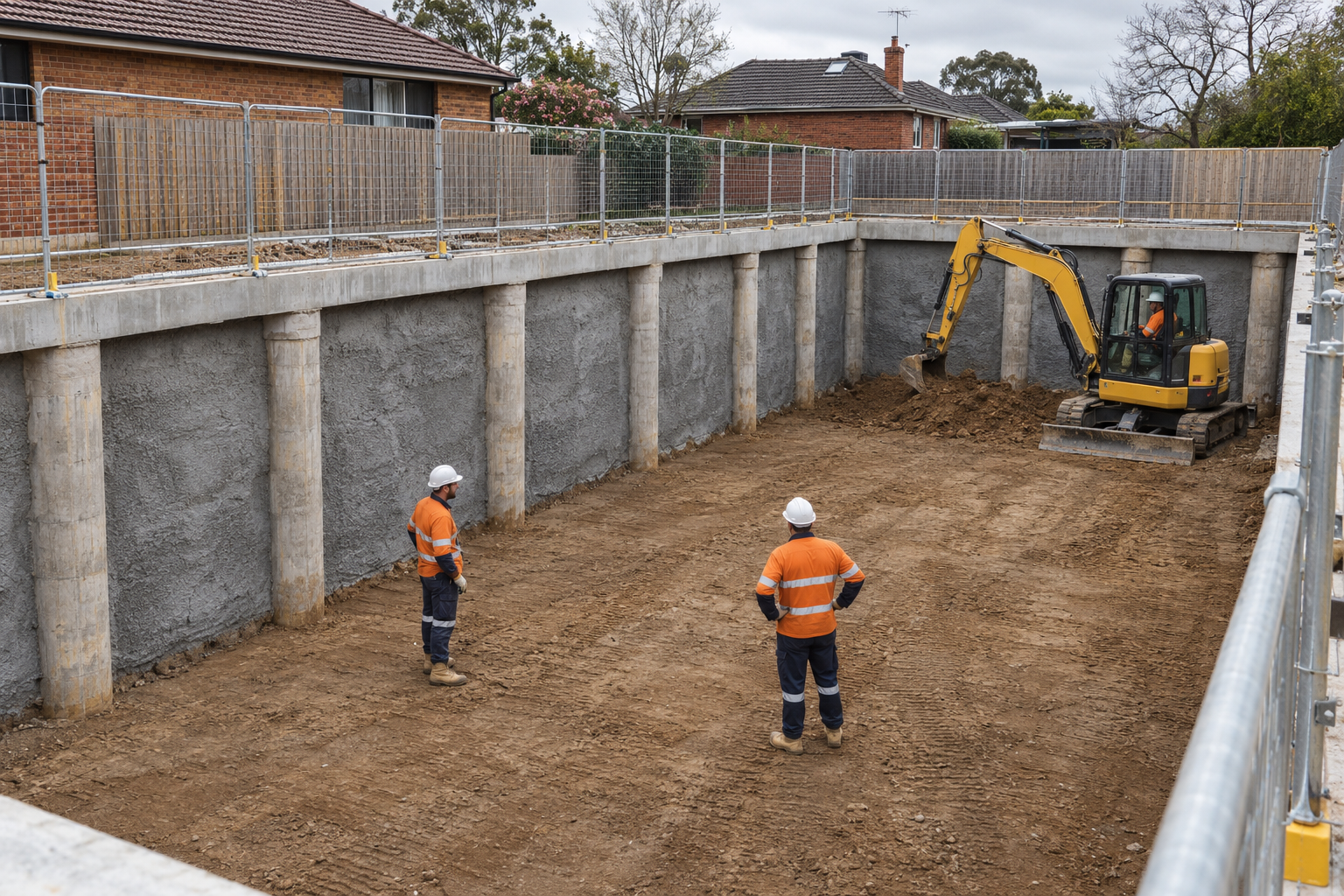
A Melbourne guide to basement construction: feasibility, approvals, build stages, cost drivers and design decisions.
See more
What structural concrete is, the main types, the strength grades used in Australia and where each is used on site.
See more